مركز مراقبت هاي كودكان بي سرپرست آلمان شهر روستوك
Pilot Project in Wustrow on the Baltic Sea
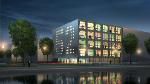
The first plus-energy building of Germany's Northeast is a day-care facility for 113 children. It was realised by buttler architekten based in Rostock.
Architects: buttler architekten, Rostock
Location: Strandstraße 14, 18347 Ostseebad Wustrow

day-care facility in Wurstrow, poto: buttler architekten
Back in 2008 – long before the disaster in Fukushima – the municipality of the Baltic Sea Bath Wustrow and buttler architekten got together to develop a concept for a plus-energy kindergarten. It was intended to be the very first plus-energy building in the Federal State of Mecklenburg-Vorpommern.
The new building is CO2 neutral in operation, and gives rise to significantly lower annual CO2 emissions compared to a similar building constructed in compliance with the German Energy Saving Ordinance (EnEV 2009) – equivalent to a saving of 30 metric tons of CO2 emissions. The concept developed for the building and its technical equipment had the primary aim of reducing energy consumption (heat and electricity) in correspondence with a passive house design. The selected combination of highly insulated lightweight façades and solid ceilings on concrete supports is advantageous for several reasons: good thermal insulation and storage capacities, and a thermal-bridge-free exterior shell are obtained. Power required for lighting is minimised by optimal daylight illumination, partial use of LED lighting technology, as well as a daylight-dependent lighting control system.

Ground floor

First floor

Section
The
heat requirement of the building is completely covered by environmental
thermal energy. Four 100-metre-deep borehole thermal energy storage
(BTES) tubes withdraw the required thermal energy from the soil. The
electricity needed by the heat pump is 'borrowed' from the public power
grid. The total amount of power required by the heat pump, lighting,
ventilation equipment and water pumps is produced time-delayed by a
photovoltaic system installed on the roof. A ventilation system with
heat recovery minimises the thermal energy losses due to ventilation,
and optimises indoor air quality.
Hot water generation in the
building is based on six solar heat collectors installed at an
inclination of 35 degrees on the roof facing south. Hot water from these
is fed to two stratified storage tanks, each with a volume of 500
litres. Also installed on the roof is a 47 kWp photovoltaic system,
which is expected to produce 36,000 kWh/a per year.

Construction
The
construction of the day-care facility for children makes use of a
combination of different building methods: load-bearing and bracing
concrete components (walls, supports, ceilings) inside the building, and
non-load-bearing elements made of wood on the outside. All glass
façades and window elements are passive-house-certified mullion and
transom constructions. These are positioned at the same level of the
wood frame outer wall elements. The glass roof above the central atrium
is composed of glazing fitted over a wooden construction, a style that
is also used for the vertical façade elements. Some glass-glass
photovoltaic modules are integrated in the roof triple glazing.

Glazing with photovoltaics, photo: buttler architekten

The central atrium, photo: Thomas Ulrich
With the exception of the bracing shear walls and the core of the stairwell, the interior walls are built using dry construction systems, to allow changes in the internal building structure in response to different usage requirements in the course of time.
Project data
Client: Municipality of Ostseebad Wustrow
Design and project management: buttler architekten, Rostock
Energy design: Ingenieurbüro P. Jung, Cologne
Building services engineering design: HKS-Ingenieurbüro Ehlert, Rostock
Electrical design: IBB Elektro H. Babendererde & G. Bartoschek, Elmenhorst
Site area: 2,113 m²
Usable floor space: 968 m²
Gross floor area of all storeys: 1,133 m²
Total
construction costs (gross): 1,781,000 € (Cost Group 300 (structure -
construction) + 400 (structure - technical facilities) + 255,000 € for
PV system
Construction period: 2010 to 2011

Façade on the South, photo: buttler architekten

Façade on the East, photo: buttler architekten
 با اهداء سلام